Box Fan Air Filter vs Air Purifier: Better?
When deciding between a box fan air filter and a dedicated air purifier, the choice really depends on your budget and your specific air cleaning needs. For basic dust and allergen control on a tight budget, a DIY box fan filter setup can be surprisingly effective. If you need more powerful, multi-stage filtration for serious air quality issues like smoke or strong odors, a dedicated air purifier is generally the better investment.
Many people look for affordable ways to improve their indoor air. A box fan with a furnace filter attached is a popular DIY solution that can help capture larger particles. However, dedicated air purifiers offer more advanced features and are designed specifically for sustained, efficient air cleaning. We found that both have their place, but understanding their strengths is key.
- Box fan filters are budget-friendly for basic dust.
- Dedicated purifiers offer advanced filtration for tougher pollutants.
- Consider your budget and air quality goals.
- Box fans are DIY-friendly; purifiers are plug-and-play.
Let’s break down how each option works and help you figure out which one is the best fit for your home.
Box Fan Filter vs. Air Purifier: Which Cleans Your Air Better?
Deciding between a DIY box fan air filter and a store-bought air purifier can feel overwhelming. Both aim to improve your indoor air quality. We found that a box fan filter is a great budget-friendly option for basic particle removal. A dedicated air purifier, on the other hand, often provides more advanced and targeted filtration. Let’s look at how each one works.
Understanding the Box Fan Air Filter (The DIY Approach)
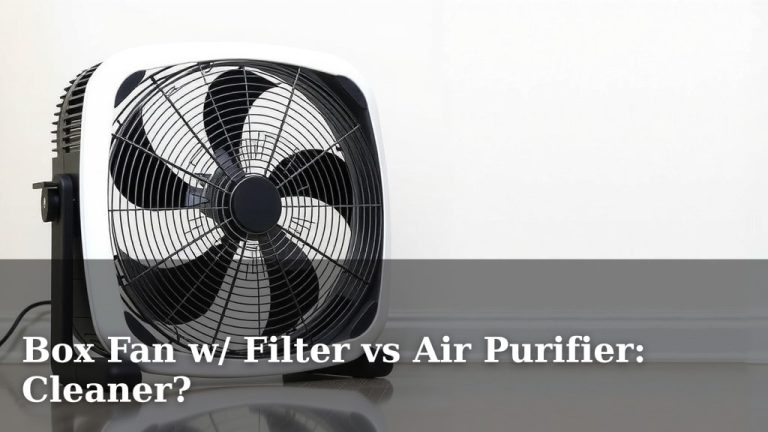
The box fan air filter is essentially a standard box fan with a furnace filter taped to the back. You might have seen this online or heard about it from friends. It’s a simple setup designed to pull air through the filter. This helps capture airborne particles like dust and pet dander. Many people choose this method because it’s incredibly cost-effective.
How It Works: Simple Mechanics
A box fan, as you know, is designed to move a lot of air. When you attach a furnace filter, the fan draws room air through the filter media. The filter’s material acts like a sieve. It traps larger particles that would otherwise circulate in your home. The effectiveness depends on the filter’s MERV rating (Minimum Efficiency Reporting Value). A higher MERV rating means it can capture smaller particles.
What It Captures Best
This DIY setup is surprisingly good at capturing larger airborne particles. Think dust bunnies, pollen, and pet hair. It can make a noticeable difference in reducing the amount of visible dust in your home. It’s a practical way to give your living space a quick clean-up. You might even find yourself dusting less often.
Limitations to Consider
However, box fan filters have their limits. They are generally not designed for very fine particles like smoke, viruses, or strong odors. The fan motor itself isn’t built for continuous, high-level filtration. Running it for long periods might shorten the fan’s lifespan. Also, the seal between the filter and the fan isn’t always perfect, allowing some air to bypass the filter.
Exploring Dedicated Air Purifiers (The Engineered Solution)
A dedicated air purifier is a purpose-built appliance. Manufacturers design these units specifically for cleaning indoor air. They often use multi-stage filtration systems. This means they can tackle a wider range of pollutants than a simple box fan filter. They are generally more expensive upfront but offer more robust performance.
The Technology Inside: More Than Just a Fan
Air purifiers typically feature a combination of filters. The most common is a HEPA (High-Efficiency Particulate Air) filter. Medical-grade HEPA filters can capture 99.97% of particles as small as 0.3 microns. This includes allergens, mold spores, and even some bacteria. Many also include activated carbon filters. These are excellent for absorbing odors and volatile organic compounds (VOCs) from cleaning products or furniture.
What They Excel At
Air purifiers are engineered to handle a broad spectrum of air contaminants. They are highly effective against fine dust, pet dander, pollen, mold spores, and even smoke particles from wildfires or cooking. If you have allergies, asthma, or are sensitive to odors, a good air purifier can provide significant relief. Some models even have UV-C light technology to help neutralize germs.
Advanced Features and Benefits
Beyond filtration, many air purifiers offer smart features. These can include air quality sensors that automatically adjust fan speed. Some models connect to Wi-Fi, allowing you to control them via a smartphone app. You might also find models with quiet modes for nighttime use. These features provide a convenient and optimized air cleaning experience.

Key Differences: A Quick Comparison
Let’s lay out the main distinctions. It’s helpful to see them side-by-side to make the best choice for your home. Think of it like choosing between a basic toolkit and a professional workshop.
| Feature | Box Fan Filter | Dedicated Air Purifier |
|---|---|---|
| Initial Cost | Very Low ($20-$50) | Moderate to High ($100-$500+) |
| Filtration Power | Basic (MERV rated furnace filter) | Advanced (HEPA, Activated Carbon) |
| Particle Capture | Larger particles (dust, pollen) | Fine particles (smoke, allergens, VOCs) |
| Odor Control | Minimal | Often excellent (with carbon filter) |
| Noise Level | Can be noisy (fan dependent) | Varies; many quiet options available |
| Energy Use | Moderate | Varies by model; often efficient |
| Lifespan/Durability | Fan motor may wear faster | Designed for long-term use |
Cost vs. Performance: What’s Your Priority?
Your budget is often the biggest factor. A box fan filter is incredibly cheap to set up. You buy a fan and a filter, and you’re good to go. However, you’ll need to replace filters regularly. Air purifiers have a higher upfront cost. But they often use more efficient filters designed to last longer. You also need to factor in replacement filter costs for both options. We found that the long-term cost can be similar, depending on usage and model choice.
Air Quality Goals: What Are You Trying to Solve?
What’s bothering you most about your indoor air? If it’s just visible dust and you’re on a tight budget, the box fan filter might be sufficient. For more serious concerns like allergies, asthma, smoke, or strong odors, a dedicated air purifier is a much better investment. Many health organizations recommend HEPA filtration for allergy sufferers (CDC). A box fan filter just doesn’t offer that level of purification.
Consider this checklist when making your decision:
- Your budget for initial purchase.
- Your budget for ongoing filter replacements.
- The main pollutants you want to remove.
- How sensitive are you or your family to allergens or odors?
- Do you need features like timers or app control?
- How important is quiet operation to you?
Conclusion
Deciding between a box fan filter and a dedicated air purifier boils down to your priorities. For a budget-friendly dust solution, the DIY box fan setup can get the job done. We found it’s great for larger particles. However, if you’re battling allergies, smoke, or strong odors, a dedicated air purifier offers superior, multi-stage filtration. Think of the purifier as your heavy-duty air cleaning tool. To make the best choice, assess your budget and exactly what air quality issues you need to tackle. If cleaner air is a priority, take the next step: research models that fit your specific needs and budget.
Frequently Asked Questions
Can a box fan filter actually improve my indoor air quality?
Yes, a box fan filter can improve your indoor air quality by capturing larger airborne particles like dust, pollen, and pet dander. We found it makes a noticeable difference in reducing visible dust. It’s a simple, cost-effective way to deal with basic air cleanliness.
How often should I replace the filter on my box fan setup?
You should replace the filter on your box fan setup approximately every 1 to 3 months, or sooner if it appears visibly dirty or your air quality hasn’t improved. Check the filter regularly, as dust accumulation can quickly reduce its effectiveness and strain the fan motor.
Are air purifiers noisy compared to box fans?
Noise levels vary for both. Box fans can be quite loud, depending on the model and fan speed. Many dedicated air purifiers offer multiple fan speeds, including quiet or sleep modes designed for minimal noise. We found some purifiers are much quieter than even a low-setting box fan.
What is a HEPA filter and why is it important in air purifiers?
A HEPA filter is a high-efficiency particulate air filter that can capture 99.97% of airborne particles 0.3 microns in size. This includes very fine dust, pollen, mold spores, and pet dander. For serious allergy or asthma sufferers, this level of filtration is critical for improving air quality.
Can a box fan filter help with pet odors?
A basic box fan filter is generally not effective at removing pet odors. Odor particles are typically much smaller and require specialized filtration, like activated carbon filters found in most dedicated air purifiers. If odors are a concern, a purifier is a much better choice.