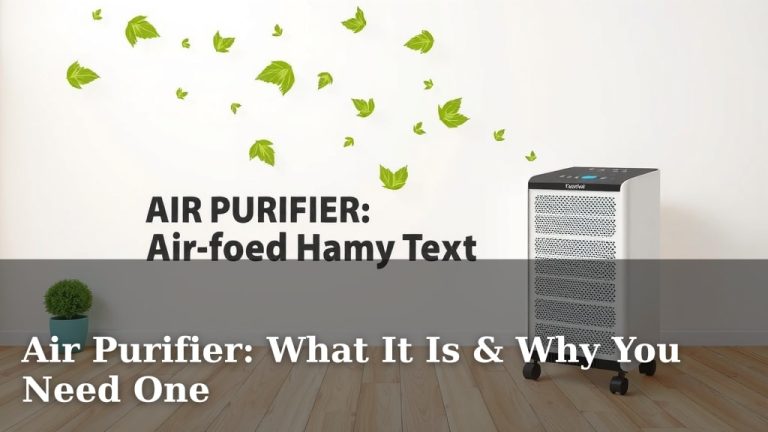
How Do Air Purifiers Work? A Simple Explanation for Beginners
Have you ever wondered what happens inside those sleek devices sitting in your living room or bedroom? Air purifiers have become increasingly popular in modern homes, yet many people don’t really understand how they function. If you’re curious about the technology behind these machines and whether they actually make a difference in your indoor air quality, you’ve come to the right place.
Think of an air purifier as a bouncer at a nightclub—its job is to filter out the unwanted guests (pollutants) and let only the clean air through. But unlike a bouncer who makes quick judgments, an air purifier uses sophisticated technology to trap harmful particles, gases, and odors. Let’s dive deep into understanding how these devices work and why they matter for your health.
Understanding Indoor Air Quality and Why It Matters
Before we explore how air purifiers work, it’s important to understand why indoor air quality has become such a big deal. Most of us spend about 90% of our time indoors, whether at home, work, or in cars. During this time, we’re breathing air that might be filled with various pollutants.
Indoor air can contain dust particles, pet dander, pollen, mold spores, bacteria, viruses, and volatile organic compounds (VOCs) from household products. These invisible invaders can trigger allergies, worsen asthma symptoms, and contribute to long-term respiratory problems. This is where air purifiers step in to save the day.
The Basic Principle Behind Air Purifiers
At their core, air purifiers operate on a simple principle: pull in dirty air, clean it, and push out fresh air. The entire process happens continuously, cycling the air in your room multiple times per hour. But the magic lies in how they clean that air during the process.
Most air purifiers use a combination of filtration technologies rather than relying on just one method. This multi-layered approach ensures that different types of pollutants get captured effectively. It’s similar to how a water filtration system uses multiple stages to remove different impurities from water.
The Core Components of an Air Purifier
Every air purifier consists of several essential components that work together in harmony. Understanding these parts will help you appreciate how the entire system functions.
- A motor and fan that draws air into the device
- Multiple filtration stages that trap different types of pollutants
- A chamber where the filtration process occurs
- An outlet that releases purified air back into the room
The Mechanical Filtration Process: HEPA Filters Explained
The most recognizable and important part of most air purifiers is the HEPA filter. HEPA stands for High-Efficiency Particulate Air, and these filters are absolute champions when it comes to trapping tiny particles.
A HEPA filter is made from a mat of randomly arranged fibers, typically composed of fiberglass. When air passes through this mat, particles get trapped in three different ways. First, larger particles simply get caught directly on the fibers, like leaves getting stuck in a net. Second, some particles collide with fibers and stick to them through a process called interception. Finally, the smallest particles get captured through diffusion, where they bounce around randomly and eventually stick to a fiber.
How Effective Are HEPA Filters?
Here’s the impressive part: true HEPA filters are capable of capturing 99.97% of particles that are 0.3 micrometers or larger. To put this in perspective, a human hair is about 100 micrometers wide, so we’re talking about filtering incredibly tiny particles. This includes dust mites, pollen, pet dander, and even some bacteria and viruses.
However, it’s crucial to note that not all filters labeled as “HEPA-type” or “HEPA-like” meet this standard. Only filters certified as true HEPA filters by the Department of Energy achieve this level of filtration efficiency.
Pre-Filters: The First Line of Defense
Before air even reaches the HEPA filter, it usually passes through a pre-filter first. Think of the pre-filter as the security checkpoint before you get to the main event.
Pre-filters are typically made from foam or mesh materials and are designed to catch larger particles like dust, hair, and pet fur. By trapping these bigger particles, the pre-filter extends the life of the more expensive HEPA filter underneath. Without a pre-filter, your HEPA filter would get clogged much faster and need replacing more frequently.
Maintaining Your Pre-Filter
The good news is that pre-filters are often washable and reusable. You can simply vacuum them or rinse them under water every few weeks to restore their effectiveness. This makes them an economical part of the air purification system.
Activated Carbon Filters: Capturing Gases and Odors
HEPA filters are great at trapping particles, but they can’t remove gases and odors. This is where activated carbon filters come into play. Activated carbon is a specially processed form of carbon with a porous structure that has an enormous surface area for its size.
When gases and odor molecules come into contact with activated carbon, they get absorbed into the pores through a process called adsorption. It’s different from absorption, where something soaks in like water on a sponge. Instead, the gas molecules actually stick to the surface of the carbon particles. Cooking smells, cigarette smoke, chemical fumes from cleaning products, and even some volatile organic compounds all get trapped this way.
The Limitations of Activated Carbon
While activated carbon is excellent at removing odors and gases, it has a finite capacity. Eventually, the pores fill up, and the filter can no longer absorb more pollutants. This is why activated carbon filters need regular replacement, usually every 3 to 6 months depending on usage and air quality in your home.
Advanced Filtration Technologies
Modern air purifiers often go beyond the basic HEPA and activated carbon combination. Many manufacturers have developed additional filtration technologies to target specific pollutants more effectively.
Photocatalytic Oxidation (PCO)
Some air purifiers use photocatalytic oxidation technology that combines ultraviolet light with a catalyst material (usually titanium dioxide) to break down pollutants at a molecular level. When harmful substances pass through the PCO filter under UV light, they get chemically transformed into harmless compounds like water and carbon dioxide.
Ionization Technology
Ionizers work by releasing negatively charged ions into the air. These ions attach to positively charged particles like dust and pollen, causing them to become heavy enough to fall out of the air and settle on surfaces. However, it’s important to note that ionizers don’t actually remove these particles from your home—they just make them fall to the ground where they can be vacuumed up.
Ozone Generators: A Word of Caution
Some devices claim to use ozone to purify air, but health experts generally advise against this technology. Ozone is actually a pollutant itself and can irritate your respiratory system. The EPA and other health organizations warn against using ozone generators for home air purification.
How Air Circulation Works in Air Purifiers
The filtration doesn’t matter much if air doesn’t actually reach the filters. This is where the motor and fan system becomes crucial. Most air purifiers use a motorized fan to create airflow that pulls air into the device from all directions.
The motor powers the fan blades, which spin at varying speeds depending on the purifier’s settings. Higher speeds mean more air gets pulled through the filters, but it also means more noise. This is why many air purifiers offer multiple speed settings, allowing you to balance between air cleaning effectiveness and noise level.
Air Changes Per Hour (ACH)
The effectiveness of an air purifier depends partly on how much air it can process. This is measured in something called Air Changes Per Hour, or ACH. An ACH of 3 means the air purifier can completely filter all the air in a room three times in one hour. For optimal air quality, experts generally recommend an ACH of at least 4 to 5 for rooms where you spend significant time.
The Complete Journey of Air Through a Purifier
Let me walk you through the complete journey of a dust particle as it travels through an air purifier. Understanding this process really helps you grasp how effective these devices actually are.
First, the motorized fan creates negative pressure, sucking air and particles toward the intake vents. The dust particle enters the device along with thousands of other particles and gas molecules. It first encounters the pre-filter, which traps larger particles. If our dust particle is small enough to pass through, it continues to the HEPA filter, where it gets trapped in the mat of fibers through one of the three mechanisms I mentioned earlier.
Meanwhile, any odor molecules or gases in the air pass through the activated carbon layer, where they get adsorbed. The now-clean air exits through the outlet, and the purifier draws in more polluted air to repeat the process. This cycle continues constantly as long as the purifier is running.
Different Types of Air Purifier Technologies
Not all air purifiers work exactly the same way. Different manufacturers use different combinations of technologies based on their target use cases.
Mechanical Air Purifiers
These are the most common type and rely entirely on physical filtration through HEPA filters and activated carbon. They’re effective, reliable, and don’t produce any harmful byproducts like ozone. This is why most health-conscious consumers prefer mechanical air purifiers.
Electronic Air Purifiers
Electronic purifiers use electrostatic technology or ionization to charge particles and attract them to collection plates. While they can be effective, they often produce some ozone as a byproduct, which is why mechanical purifiers are generally considered safer.
Factors That Affect Air Purifier Performance
Several factors determine how well an air purifier will work in your specific situation. Just having a good air purifier isn’t enough—you need to use it correctly and understand what influences its performance.
Room Size and Placement
Air purifiers are rated for specific room sizes based on their Clean Air Delivery Rate (CADR). If you use a small purifier in a large room, it simply won’t be able to process all the air effectively. Similarly, where you place the purifier matters. Putting it in a corner or behind furniture restricts airflow and reduces effectiveness. It’s best to place your purifier in a central location with adequate space around it.
Filter Maintenance and Replacement
Even the best air purifier won’t work well if you neglect filter maintenance. Pre-filters need regular cleaning, and HEPA filters need replacement every 6 to 12 months depending on usage. Activated carbon filters typically need replacement every 3 to 6 months. Ignoring these maintenance requirements means the filters become clogged and less effective.
Sealing Your Space
Air purifiers work best when doors and windows are closed. If your room has large air leaks, outside pollutants will keep entering faster than your purifier can clean them. Think of it like trying to fill a bathtub with the drain open—the purifier is your water source, but if there are leaks, you’re fighting an uphill battle.
How Long Does It Take to Notice Results?
Many people wonder when they’ll start feeling the benefits of using an air purifier. The timeline varies depending on several factors including the purifier’s strength, room size, and your sensitivity to air quality changes.
Some people with allergies notice improvements within a few days as pollen and pet dander levels drop. Others might need a week or two before they observe significant changes. The important thing is to be patient and ensure proper maintenance throughout this period. Also, remember that air purifiers work best when combined with other healthy practices like regular vacuuming, dusting, and proper ventilation.
Common Misconceptions About Air Purifiers
There’s a lot of misinformation floating around about air purifiers, so let me clear up a few common misconceptions.
First, air purifiers don’t add anything beneficial to your air. They simply remove harmful substances. Second, they won’t eliminate all viruses or bacteria—they can capture some, but not necessarily all. Third, they won’t eliminate strong smells permanently if you keep using the source of that smell. An air purifier will reduce cooking odors, but if you keep cooking intensely, the smell will persist. Finally, air purifiers aren’t a substitute for proper ventilation and fresh outdoor air. They complement a healthy indoor air strategy but shouldn’t be your only approach.
Choosing the Right Air Purifier for Your Needs
Now that you understand how air purifiers work, you might be wondering which one to choose. The best air purifier for you depends on your specific needs and circumstances.
Consider the following factors: the size of the room you want to purify, any specific concerns like pet allergies or chemical sensitivities, noise tolerance, budget, and available space for placement. Look for air purifiers with true HEPA filters, activated carbon layers, and a Clean Air Delivery Rate appropriate for your room size. Reading real customer reviews can also provide valuable insights into long-term reliability and maintenance requirements.
Conclusion
Air purifiers work through a combination of mechanical and chemical filtration processes that remove particles, gases, and odors from your indoor air. The multi-layered approach involving pre-filters, HEPA filters, and activated carbon ensures comprehensive air cleaning. While they’re not a magic solution that eliminates all indoor air quality problems, they’re highly effective tools for reducing common pollutants when used correctly and maintained properly.
Understanding how air purifiers function helps you make informed decisions about whether they’re right for your home and how to maximize their effectiveness. Combined with good ventilation practices, regular cleaning, and proper maintenance, an air purifier can significantly improve your indoor air quality and contribute to better respiratory health for you and your family.
Frequently Asked Questions
How often should I replace my air purifier filters?
Pre-filters can usually be cleaned and reused every few weeks, but HEPA filters typically need replacement every 6 to 12 months depending on usage and air quality. Activated carbon filters generally require replacement every 3 to 6 months. However, these timelines can vary significantly based on how much you use your purifier and how polluted your air is. Check your specific model’s recommendations and monitor filter appearance for visual cues of replacement needs.
Can air purifiers remove viruses and bacteria completely?
HEPA filters can capture many bacteria and some viruses that are attached to larger particles, but they cannot remove all viruses or bacteria. Some viruses are extremely small and may pass through filters, while others might not be attached to particles large enough to be filtered. Air purifiers should be part of a comprehensive approach to health that includes proper ventilation, regular cleaning, and following guidelines from health authorities.
Is it safe to leave an air purifier running 24/7?
Yes, most air purifiers are designed to run continuously and are safe for 24/7 operation. In fact, running your air purifier constantly can be beneficial as it continuously removes pollutants from your air. However, you’ll need to keep up with filter maintenance more frequently. The main concern is energy consumption, which varies depending on the model’s size and power requirements.
Do air purifiers make noise, and is it a concern?
Most air purifiers produce some noise, especially when running at higher speeds. The noise level typically ranges from about 20 decibels on the lowest setting to 60 or more decibels on the highest setting. Many people find the noise acceptable, especially since most air purifiers run quieter than a